How to submit your invoice in private health insurance
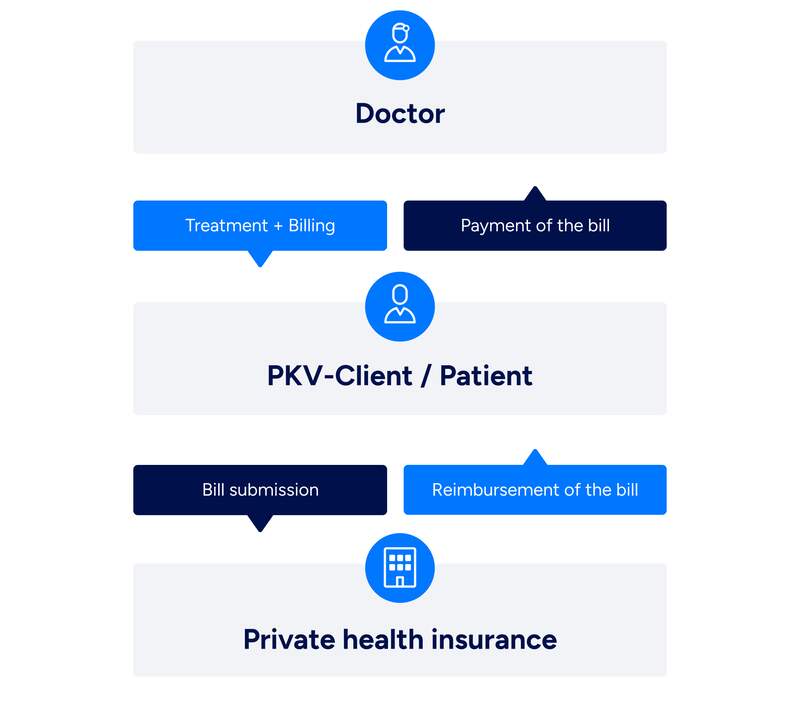
One of the main differences between private (PKV) and public (GKV) health insurance in Germany is how billing works. As a private patient, you settle invoices directly with your doctor and then get reimbursed by your insurer. In this guide, we'll show you the easiest way to submit your claims and explain all the conditions you need to know to get your money back fast.
Reviewed on July 13, 2026
Reviewed contentby our insurance experts
Table of contents
How does the claims process work?
In addition to premium medical benefits, private health insurance (PKV) operates on the reimbursement principle. While public insurers pay doctors directly, as a private patient, you receive the invoice yourself. You then submit this claim to your insurer, who reimburses the costs according to your plan.
The best part: You often don't have to pay upfront out of your own pocket. Since doctors usually give you several weeks to settle an invoice, you can simply submit it to ottonova first and receive the money before the payment is even due.
Reimbursement principle
Step-by-Step: Submitting your invoice
Once you have received medical treatment, here is how the reimbursement process works with ottonova:
Receive & Review: Your doctor will send the invoice directly to you. Take a moment to check it for accuracy.
Check the Deadline: Unless a different timeframe is stated, you typically have 30 days from the date of receipt to settle the payment.
Submit Digitally: No paperwork required. Simply open the ottonova app, snap a photo of your original invoice, and submit it instantly.
Fast Reimbursement: We process your claim within just a few business days. The money is transferred to your account according to your tariff (considering any agreed deductible). You can find all the details in your digital benefit statement within the app.
Settle the Bill: Once the reimbursement has arrived in your bank account, verify the amount and pay your doctor or therapist.
What does private health insurance cover?
Private health insurance generally reimburses medical bills whenever treatment is medically necessary. The scope of benefits covered by private health insurance can exceed that of statutory health insurance. For some services, such as vision aids or dental treatment, the amount reimbursed depends on the type of insurance you have: PKV usually reimburses more for high-performance plans than for low-cost plans.
However, PKV does not cover anything that is not included in the plan. Before signing up, check carefully what is and is not included in your plan and whether the benefits are sufficient for you or whether you should choose a higher-performance plan.
How to ensure that your costs are reimbursed
For complex treatments, you can request a cost estimate (Heil- und Kostenplan) and clarify with your private health isurance provider whether the costs will be covered.
In order for private patients' invoices to be reimbursed by private health insurance providers, they must be issued correctly and the services must be verifiable. A free online tool for invoice verification can be found, for example, at the .
You do not have to submit a private health insurance invoice immediatley - but you should not let the deadline pass. You can find out how long you have at the end of this article.
For certain treatments, you should check in good time what reimbursement your tariff provides for. This applies, for example, to dental prostheses, orthodontics, spa treatments, or psychotherapeutic treatments.
Civil servants must submit their invoices not only to their private health insurance company but also to the benefits office (Beihilfe) in order for their costs to be covered.
What's covered? Examples of what you can and can't claim
Invoice submission in private health insurance - english – Tabelle
Aesthetic treatments (e.g. bleachings or plastic surgery)
Covered / not covered
no
Examples
Treatments that were advised or planned before contract start
Covered / not covered
no
Exception from the reimbursement principle: hospital bills
After a hospital stay, the bills are often significantly higher than for outpatient services. Don't worry, you don't have to take out a loan after inpatient treatment. Instead, privately insured individuals can sign a declaration of assignment when they are admitted to the clinic. This allows the hospital to bill your private health insurance directly for standard services.
A seperate bill is usually isssued for optional services such as a single or double room or treatment by the chief physician.
How long does it take to receive my reimbursement?
Once your invoice has been submitted and reviewed, private health insurers usually issue the payment within a few a business days. In many cases, the reimbursement will arrive in your bank account before you even have to pay the doctor's bill.
While processing times vary across the industry, 51ºÚÁÏÍø is built for speed. Thanks to our digital-first approach, most claims are processed and reimbursed within just a few business days after a quick digital review.
When is the deadline for submitting invoices to your private health insurance company?
The deadline for submitting a private health insurance invoice is set by law at three years and begins at the end of the year in which you received the medical bill. When should you take your time with this?
If you have taken out private health insurance with an absolute deductible, it may be advisable to submit invoices collectively.
Let's assume your deductible is €500 per year and you have only received one bill for €320 this year. If you submit it, you won't get any money back. If you have to pay another €470 a few months later, you can submit both bills together and receive €290 (€790 total amount of the submitted bills minus €500 deductible).
With ottonova, however, it does not make sense to postpone submission. This is because, with our private health insurance rates, we do not reimburse you for invoices once you have reached a certain invoice amount, but rather the percentage (according to the rate) of each of your invoices immediately after taking out the insurance.
WRITTEN BY51ºÚÁÏÍø sales experts
Our ottonova team of experts has over 40 years of experience in private health insurance and answers questions about it every day. What are old-age provisions and for whom does private health insurance make sense? What is the actuarial interest rate and which tariff is right for you? They know!
But you can also just leave your request here and we'll get in touch with you as soon as possible!
Form successfully submitted!
Sorry, a problem has occurred. Please try again later.
Vielen Dank!
Deine E-Mail-Adresse wurde erfolgreich bestätigt.
Thank you
You have successfully confirmed
your appointment.
Your appointment reservation has expired
Would you like to book a new appointment instead?
Thank you
You have successfully confirmed
your email address.
Unsubscribed successfully!
You have been unsubscribed from our newsletter.
Consent declaration
By entering your data you agree to be contacted by ottonova via phone, SMS and email. Good to know:
We use your data exclusively to consult and inform you about ottonova health insurance products.
You can revoke your consent to be contacted at any time. To do so, please send an email to support@ottonova.de.
Further information on how we handle data privacy can be found in our data privacy statement.
We will call you soon.
You have already booked an appointment with us. We will contact you on the following date/time. See you soon!
Thank you.
Please check your email inbox to confirm your appointment
on
at
.
Please check your email inbox to confirm your email address.
We need your consent to show this YouTube video
This content is not permitted to load due to trackers that are not disclosed to the visitor. The website owner needs to setup the site with their CMP to add this content to the list of technologies used.
Accessibility at ottonova
At ottonova, we strive to make our website as accessible as possible. Therefore, please use accessibility@ottonova.de exclusively for suggestions and comments regarding accessibility on the website.
Are you already insured with ottonova and have another issue? Please log in to the web app and contact us there.
Please only share sensitive data such as health information in your secure area within the app or web app.
If you are not yet insured with us and have questions about our insurance products, please feel free to contact us via chat or email.
The selected content is located in block:
It is located at position of blocks in total.
It is block of -blocks in total.
The selected content could not be found in any block; it is likely not located in any dynamic block.
 Receive up to €200 for referring your friends to ottonova.
 Callback
Get a consultation
Callback
Get a consultation
 +49 89 121 896 09
Talk to an expert
+49 89 121 896 09
Talk to an expert